
Rapp OptoElectronic
  • Home
  • Products
    • Photomanipulation & Microdissection (LCM)
      • Scanner-Based Photomanipulation – UGA-42 Series
        • UGA-42 Firefly
        • UGA-42 Geo
        • UGA-42 Caliburn
      • Fixed-Spot Photomanipulation – AiWon Series
        • AiWon
        • AiWon Geo
        • AiWon Caliburn
      • Advanced Photomanipulation
        • FLUCS Micro Flow Photomanipulation
        • HOLO4D Holographic Photomanipulation
      • Laser Capture Microdissection (LCM) Accuva Cellect
    • Microscopy & Imaging
      • Multi-Photon Microscopy
        • MOM
        • DF-Scope
      • Raman Microscopy
        • XperRAM C Series
      • Deep UV Microscopy
      • Spinning Disk Microscopy
        • X-Light V2
      • Further Microscopy Systems
        • BOB
        • SOM
        • OpenFrame
    • Microscope Accessories
      • Optical Couplings
        • IX3-Breadboard
        • FC-70 Series
        • LGA
      • Camera Adapter
        • IX3-CAM Adapter
        • TwinCam
        • MultiCam
      • Image Splitter
        • OptoSplit II
        • OptoSplit II BP
        • OptoSplit III
        • MultiSplit V2
    • Illumination Systems
      • LED & Bulb Systems
        • KSL2
        • UVILED
        • UVICO-2
        • FuraLED
        • OptoScan
      • Laser Systems
        • Single Line Laser
        • Laser Combiner
      • Flash Lamp Systems
        • JML-C2
        • SP-20
  • Applications
    • Ablation & Microdissection
    • DNA Damage
    • IR Temperature Jump
    • Uncaging & Photolysis
    • Optogenetics & Photostimulation
    • Photobleaching & FRAP
    • Photoconversion & Photoswitching
  • Publications
    • Ablation & Microdissection
    • DNA Damage
    • IR Temperature Jump
    • Uncaging & Photolysis
    • Optogenetics & Photostimulation
    • Photobleaching & FRAP
    • Multi-Photon Imaging
    • Microscope Illumination
    • FLUCS Micro Flow
  • About us
    • Partners
    • Team
    • Our story
    • Location
  • Events
  • Contact
  • Career
  • Click to open the search input field Click to open the search input field Search
  • Menu Menu

Tag Archive for: Cytoskeleton

Following Tubulin Dynamics during Spindle Formation using Photoconversion of mEos2

Photoconversion &-switching

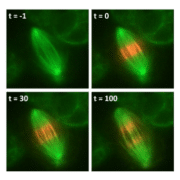
To analyze the tubulin dynamics during spindle formation, Drosophila S2 cells were transfected with mEos2-labled tubulin. By local irradiation with UV laser light (405nm) the green fluorescent mEos2 photoconverts to a red fluorescent dye. In contrast to photobleaching, where the fluorescent signal is locally depleted, the photoswitching allowed the independent observation of two different tubulin fractions in space and time.


https://rapp-opto.com/wp-content/uploads/2018/10/thorn-ucsf-spindle-elongation_x264.mp4


Movie1: Photoconversion of mEos2-labeled tubulin in the spindle of a Drosophila S2 cell. The video is sped up 20-fold from real time.

Setup:

  • Microscope: Standard widefield microscope
  • Objective: 100x NA 1.4
  • 405 & 473 nm diode laser

Rapp OptoElectronic Components:

  • UGA-40 – point scanning device (integrated in µ-manager)


Data taken from:
Kurt’s Microscopy Blog
http://nic.ucsf.edu/blog/2014/04/photobleaching-and-photoactivation/

Kurt Thorn (1) & Nico Stuurman (2)

(1) Nikon Imaging Center (NIC) at University of California – San Francisco (UCSF)
(2) Vale Lab at University of California – San Francisco (UCSF)
https://rapp-opto.com/wp-content/uploads/2018/10/photoconversion-of-meos2_thorn_icon.png 354 354 Anette https://rapp-opto.com/wp-content/uploads/2023/05/rapp-logo-340pxblau-300x79.png Anette2018-10-23 18:25:212021-07-13 14:40:32Following Tubulin Dynamics during Spindle Formation using Photoconversion of mEos2

Cutting Actin Bundles in Single Cells

Ablation & Microdissection

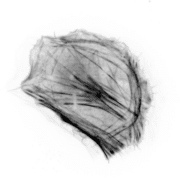
Actin bundles are the force generating part of a cell, and thus are major players during cell-mechanical processes like cell migration. By cutting individual actin fibers and quantifying the corresponding retraction, the underlying physical properties, like tension and internal forces can be determined. Additionally, by cutting force-generating stress-fibers during cell migration, cell responses, like loss of polarity and reorientation, can be observed.


https://rapp-opto.com/wp-content/uploads/2018/10/cutting-actin-fibers_x264.mp4


Movie1: Migrating Keratinocyte. Actin network was stained using life-act (shown in black; inverted LUT). Individual actin bundles were cut to analysis retraction as measure of tension within the actin network.


Setup:

  • Zeiss Observer Spinning Disk
  • 40x EC Plan-Neofluar NA 1.3 (oil)

Rapp OptoElectronic components:

  • UGA-42 Caliburn 355/42 (pulsed laser, 355nm, 1KHz, 42µJ/pulse)

Data from:

Demo data acquired together with Prof. Merkel’s group (ICS-7; Research Center Jülich) at Prof. Großhans’ Lab (Developmental Biochemistry; University of Göttingen).

https://rapp-opto.com/wp-content/uploads/2018/10/cutting-actin-bundels-in-single-cells_icon.png 354 354 Anette https://rapp-opto.com/wp-content/uploads/2023/05/rapp-logo-340pxblau-300x79.png Anette2018-10-23 17:44:152019-05-10 11:34:55Cutting Actin Bundles in Single Cells

Latest Applications

  • FLIRT: fast local infrared thermogenetics for subcellular control of protein function8. June 2021 - 15:31
  • Following Tubulin Dynamics during Spindle Formation using Photoconversion of mEos223. October 2018 - 18:25
  • Optogenetical Stimulation in Acute Brain Slices23. October 2018 - 15:43

Applications Categories

  • Ablation & Microdissection
  • DNA-Damage
  • Temperature Jump & IR-Lego
  • Uncaging & Photolysis
  • Optogenetics & Photostimulation
  • Photobleaching & FRAP
  • Photoconversion &-switching
Copyright © 2026
  • Contact
  • Newsletter
  • Imprint
  • Privacy Policy
  • Sitemap
Scroll to top Scroll to top Scroll to top